Preprints
Please note that the following articles have not been peer-reviewed.
Facing pain is effortful: key role of the supplementary motor area and anterior midcingulate cortex
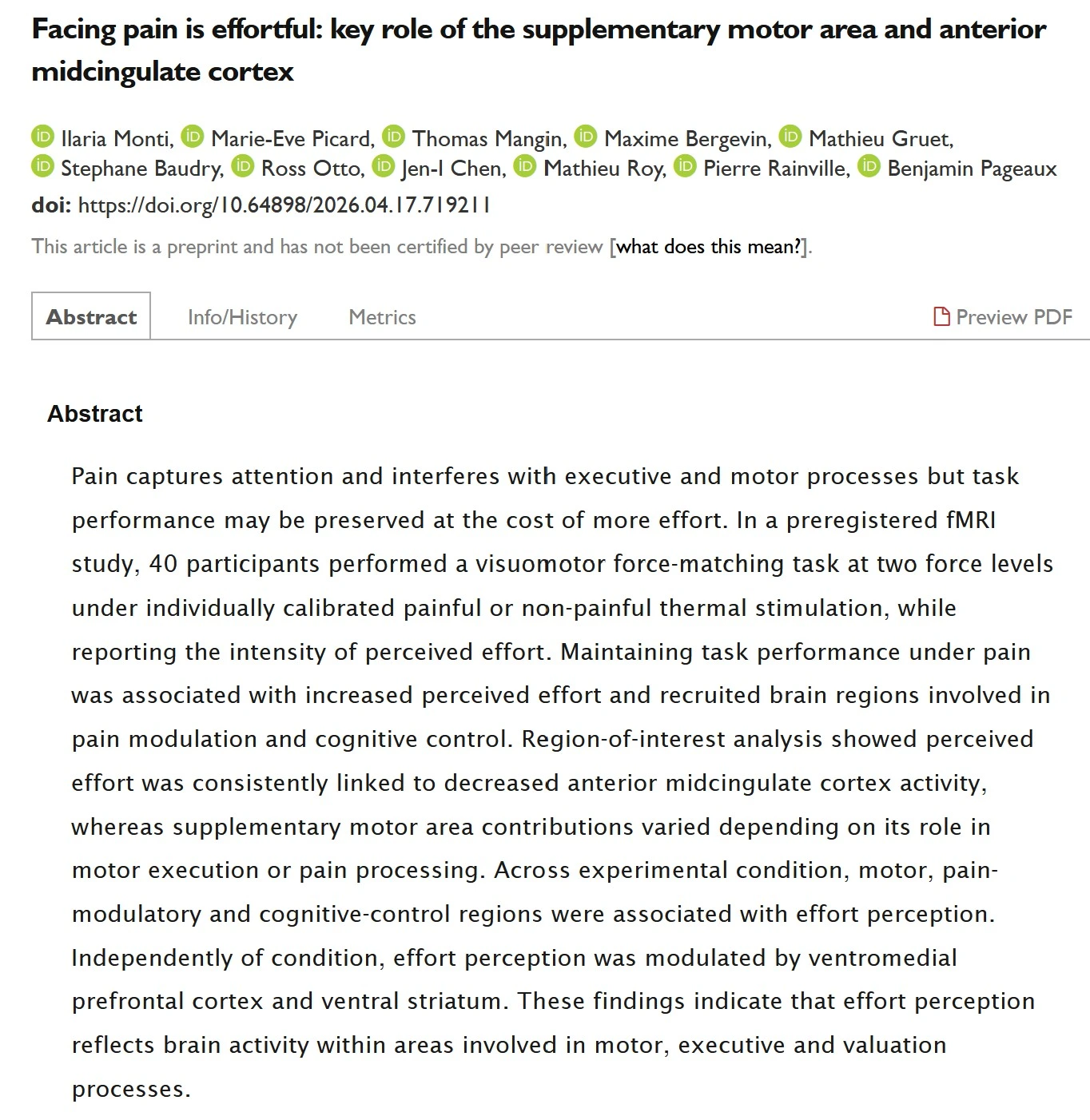
In this preprint, we sought to better understand what occurs in the brain when individuals must maintain motor performance in the presence of pain. Specifically, we started from the premise that pain does not always directly impair performance, but that remaining performant under painful conditions may require additional effort. To test this hypothesis, we conducted a preregistered fMRI study in which 40 participants performed an isometric handgrip visuomotor task at two levels of intensity, while receiving either painful or non-painful thermal stimulation. After each trial, participants reported their perceived effort and the intensity of the pain or heat experienced.
Behavioral results indicated that performance was overall maintained under painful conditions. However, this preservation of performance was accompanied by an increase in perceived effort at both force levels. In other words, coping with pain did not appear to be “cost-free”: participants were able to sustain task performance, but at the expense of a higher subjective cost.
At the neural level, we focused particularly on two regions: the supplementary motor area (SMA) and the anterior midcingulate cortex (aMCC). Our analyses show that these regions play an important role, although not in a simple or uniform manner. The aMCC was consistently associated with perceived effort, whereas the contribution of the SMA varied depending on whether the increase in effort was primarily driven by greater force demands or by the presence of pain. These findings suggest that perceived effort does not solely reflect motor command, but also involves processes related to control, pain modulation, and action cost evaluation.
More broadly, we also observed that perceived effort was associated with activity in regions involved in motor, executive, and motivational processes. In particular, regions linked to subjective value and motivation, such as the ventromedial prefrontal cortex and the ventral striatum, were modulated independently of the experimental conditions. This supports the view that perceived effort constitutes an integrative signal, reflecting both the resources mobilized to act and the subjective cost of that mobilization.
Overall, this work reinforces the idea that maintaining performance under pain is an active and costly process. It further supports a conception of effort as a phenomenon that is simultaneously motor, cognitive, and motivational, rather than a simple mechanical consequence of action.
To cite this preprint : Monti, I., Picard, M.-E., Mangin, T., Bergevin, M., Gruet, M., Baudry, S., Otto, A. R., Chen, J.-I., Roy, M., Rainville, P., & Pageaux, B. (2026).Facing pain is effortful: key role of the supplementary motor area and anterior midcingulate cortex [Preprint]. bioRxiv. https://doi.org/10.64898/2026.04.17.719211
StroopApp: an open-source Stroop application for researchers and clinicians.

In this work, we present StroopApp, an open-source software designed to administer Stroop tasks in a standardized manner, without requiring complex installation or programming skills. Our objective was to provide a tool that is precise, flexible, and user-friendly, given that implementing this type of task often relies either on costly software or on solutions requiring substantial technical expertise..
In the associated manuscript, we also note that the Stroop task is widely used to assess inhibitory control, as well as to investigate questions such as self-control, ego depletion, and cognitive fatigue. An important methodological issue is that, when the task is repeated over extended periods, learning effects may emerge and partially obscure the effects of interest. StroopApp was designed to address this challenge, notably through more advanced configurations, modified Stroop variants, and real-time performance monitoring.
From a practical standpoint, we placed particular emphasis on accessibility. The software features a modern graphical user interface, simple yet customizable configuration, real-time visual monitoring of the session, and automated data export. We also sought to facilitate its deployment and enhance the reproducibility of experimental protocols by distributing it in a format that can be readily used by researchers and clinicians.
In the manuscript available on GitHub, we also position StroopApp relative to existing tools. Some software solutions are highly precise but costly or require substantial training, whereas others are free but often require coding to be fully customizable. StroopApp thus represents a valuable compromise between precision, ease of use, accessibility, and openness.
Finally, we present a technical evaluation demonstrating that the software enables reliable measurement of reaction times, while remaining free of charge and readily usable in research, clinical, and educational settings.
To cite this preprint et software:
Mylan Beghin, Benjamin Pageaux, & Thomas Mangin. (2026). StroopApp: an open-source Stroop application for researchers and clinicians. Software archive on Zenodo. https://doi.org/10.5281/zenodo.19679923
You can see the associated manuscript by clicking here
You can download and test the software by clicking here
Maintaining performance under pain is effortful: experimental and computational evidence
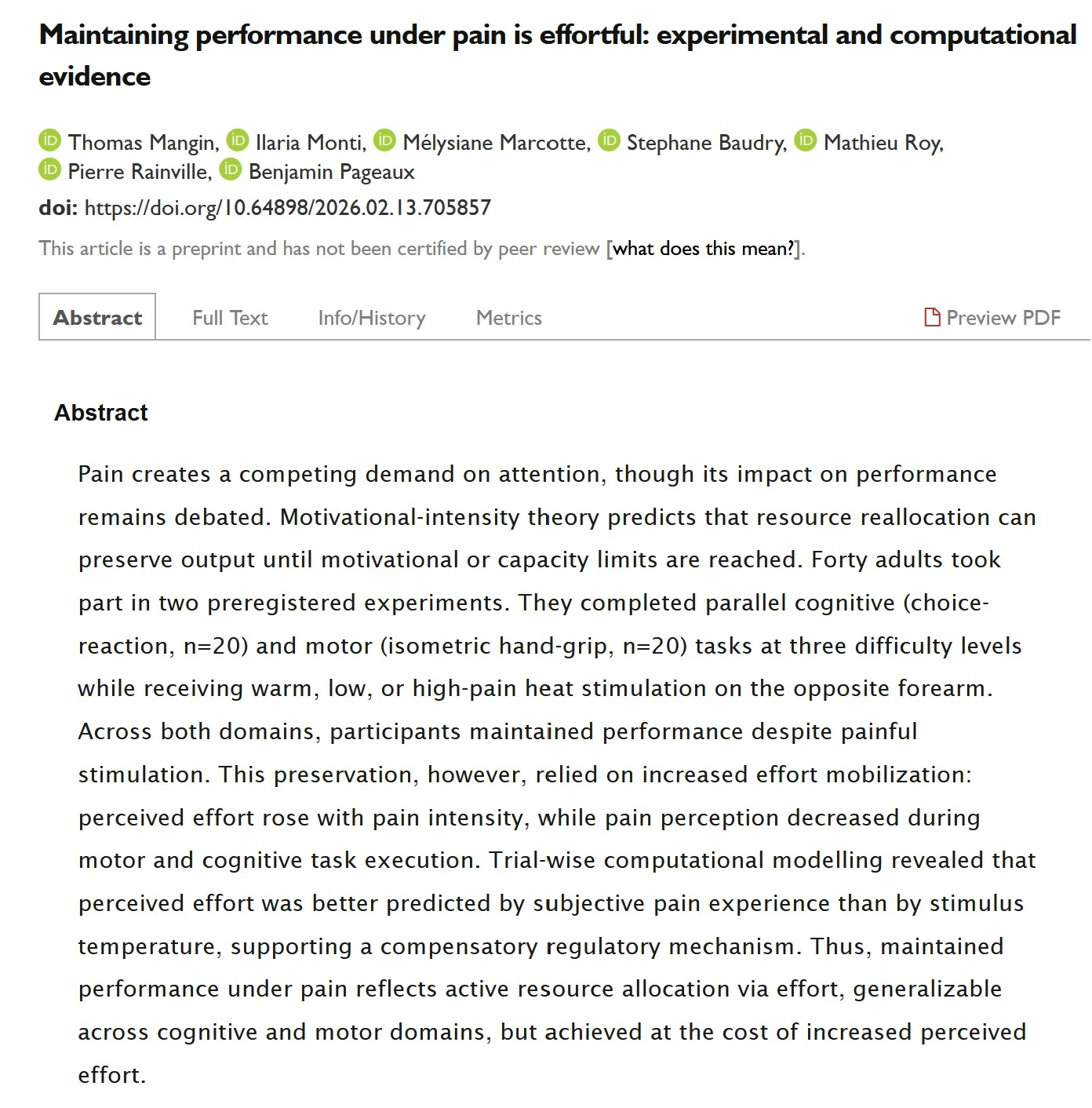 In this preprint, we investigated how pain influences performance in cognitive and motor tasks, and sought to understand why performance is not always impaired in the presence of pain. More specifically, we tested the idea that maintaining performance under pain does not occur “for free,” but instead requires an additional mobilization of resources, reflected in an increase in perceived effort. To test this, we conducted two preregistered experiments, one in the cognitive domain and the other in the motor domain, independently manipulating task difficulty and the intensity of thermal stimulation.
The results show that, in both domains, participants were generally able to maintain their performance despite the presence of pain. However, this maintenance was accompanied by an increase in perceived effort as pain intensity increased. At the same time, perceived pain decreased when participants performed more demanding tasks, suggesting a task-induced hypoalgesia effect. In other words, remaining performant under pain appears to be possible, but it comes at an additional subjective cost.
The computational analyses further support this interpretation. They show that perceived effort is better predicted by the pain actually experienced than by the objective intensity of the thermal stimulation. This suggests that perceived effort reflects less the nociceptive input itself than the subjective cost of the regulatory processes engaged to limit its interference with the task. The models also indicate that the relationship between task demand and perceived effort follows a logarithmic rather than a linear function, which is consistent with classic psychophysical principles and with motivational intensity theory.
Overall, this work supports the idea that pain does not systematically impair performance: under certain conditions, individuals can compensate for its effects by mobilizing greater effort. This finding is important because it shows that stable performance does not necessarily mean that pain has no impact. Instead, it may conceal a real subjective cost, observable through the perception of effort. The fact that this pattern appears in both a cognitive task and a motor task also points toward a relatively general mechanism.
Thomas Mangin, Ilaria Monti, Mélysiane Marcotte, Stephane Baudry, Mathieu Roy,
Pierre Rainville, & Benjamin Pageaux. Maintaining performance under pain is effortful: experimental and
computational evidence [preprint]. bioRxiv 2026.02.13.705857; doi: https://doi.org/10.64898/2026.02.13.705857
The central motor command, but not the muscle afferent feedback, is necessary to perceive effort
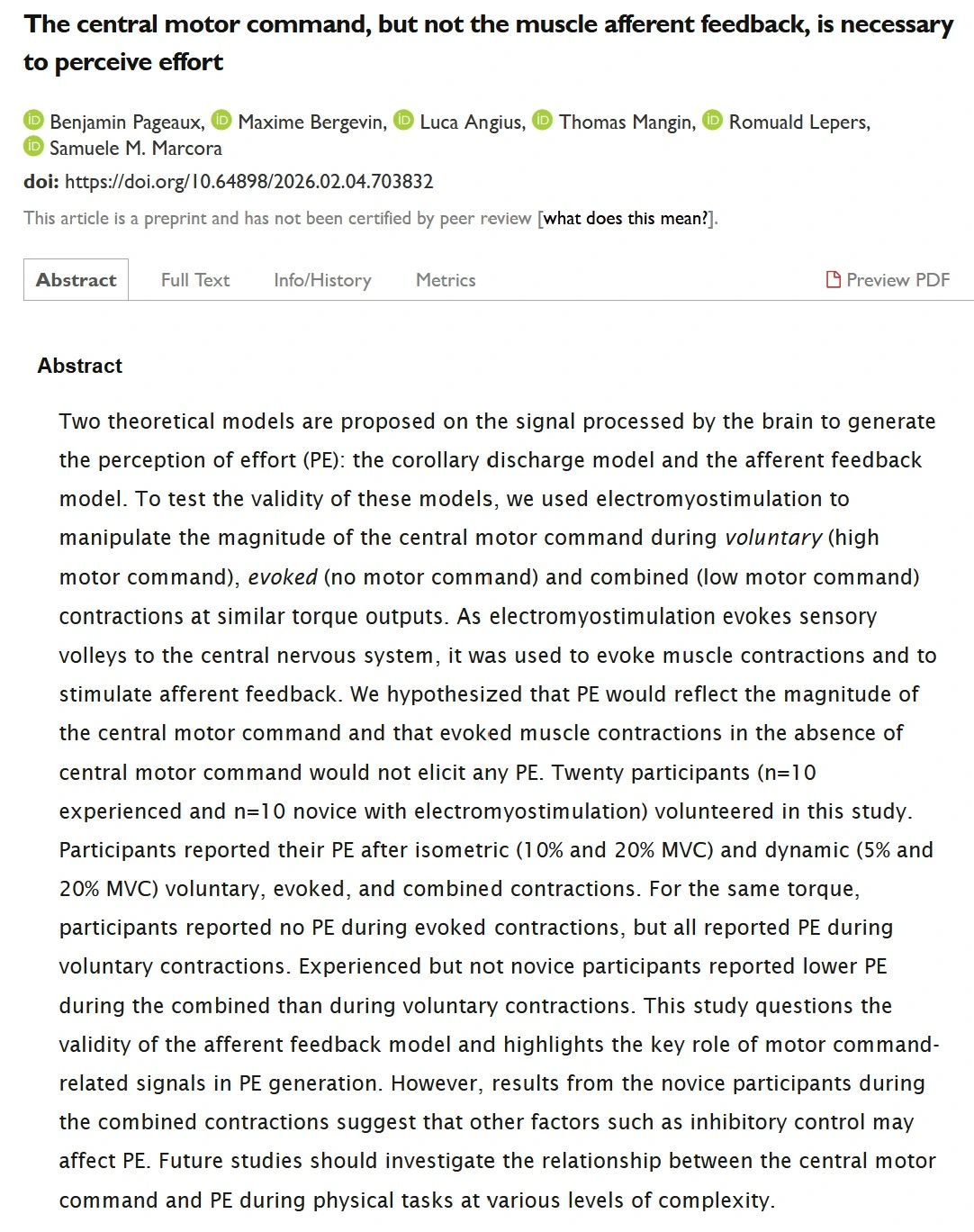 In this preprint, we tested a central question in research on the perception of effort: does perceived effort mainly arise from sensory signals coming from the muscles, or from the central motor command sent by the brain? To address this question, we used electromyostimulation to dissociate, at a comparable level of force, the central motor command and the muscular afferent feedback. Participants therefore performed voluntary contractions, stimulation-evoked contractions, or combined contractions under both isometric and dynamic conditions.
The main result is very clear: when a muscle contraction was induced by electrical stimulation without voluntary motor command, participants reported no perceived effort, despite the presence of muscular sensory feedback. In contrast, as soon as a motor command was present, effort was perceived. This finding therefore runs counter to the idea that muscular afferent feedback alone is the signal underlying the perception of effort.
The results also show that when electrical stimulation helped produce the required force, experienced participants perceived less effort than during a fully voluntary contraction. This suggests that perceived effort follows the magnitude of the central motor command more closely than the amount of feedback coming from the muscle. In contrast, among participants who were novices with electromyostimulation, this effect was less pronounced, probably because the pain or the additional cognitive control required in this situation offset the expected reduction in perceived effort.
Another important contribution of the study is that it shows perceived effort can be dissociated from other sensations associated with exercise. Participants could feel pain or a sensation of force without necessarily reporting effort, particularly during stimulation-evoked contractions. This reinforces the idea that the perception of effort constitutes a specific experience, distinct from pain, fatigue, or the simple sensation of produced force.
Overall, this work supports the corollary discharge model: the perception of effort appears to depend primarily on signals related to the central motor command, rather than directly on muscular afferent feedback. Muscular feedback likely remains important, but in a more indirect way, for example, by modulating pain, motor control, or the amount of central command required to accomplish a task.
To cite this preprint : Benjamin Pageaux, Maxime Bergevin, Luca Angius, Thomas Mangin, Romuald Lepers, & Samuele M. Marcora. (2026). The central motor command, but not the muscle afferent feedback, is necessary to perceive effort [preprint]. bioRxiv. https://doi.org/10.64898/2026.02.04.703832
Unravelling the fatigue induced by a prolonged typing task
 In this preprint, we sought to better understand fatigue induced by prolonged typing on a keyboard, an activity that is very common in daily life but still relatively understudied from a fatigue perspective. More specifically, the objective was to characterize the effects of 90 minutes of typing on subjective dimensions of fatigue, as well as on cognitive, motor, and psychomotor performance. We also examined whether this type of activity could influence the intention to engage in physical activity afterward.
The results show that prolonged typing induces greater mental fatigue and perceived effort than watching a documentary of equivalent duration. This fatigue even appears to begin relatively early, with an increase in perceived effort during the initial phases of the task, before fatigue is clearly reported. In contrast, motivation and boredom evolved similarly in both conditions, suggesting that the observed effect was indeed related to the typing task itself.
In terms of performance, the observed effects were quite specific. Prolonged typing did not impair cognitive performance on the Stroop task nor maximal force production, but it did degrade psychomotor performance. After the typing task, participants were less accurate in a subsequent psychomotor task, and their text-copying performance was also poorer than in the control condition. In other words, the fatigue induced by typing appears to manifest mainly in tasks that simultaneously involve cognitive and motor components, rather than in tasks that are purely cognitive or purely physical.
Finally, the study also shows that the intention to subsequently engage in physical activity decreased after both conditions, after typing as well as after watching the documentary. This suggests that prolonged sedentary screen-based activities may reduce the desire to engage in physical activity, regardless of the level of fatigue they induce. These results therefore reinforce the importance of incorporating regular active breaks during prolonged screen-based activities, particularly in work contexts.
To cite this preprint : Léa Vidal, Mathieu Gruet, Maxime Bergevin, Thomas Mangin, & Benjamin Pageaux. Unravelling the fatigue induced by a prolonged typing task [preprint]. https://doi.org/10.31234/osf.io/mch3k_v1